
It has been said that languages are the bridge to other cultures, and if there were a country where this idea is completely unavoidable, it would be the Netherlands – most of all, Rotterdam. With over 100 bridges and quays, Rotterdam would be completely amiss without its bridges, and the language spoken on either side of them. Inspired by the idea of languages being the bridges between cultures, I’ve compiled a list of the top 4 bridges in Rotterdam, and the European languages I think they represent, and they’d speak, if they were able.
Erasmusbrug – Greek
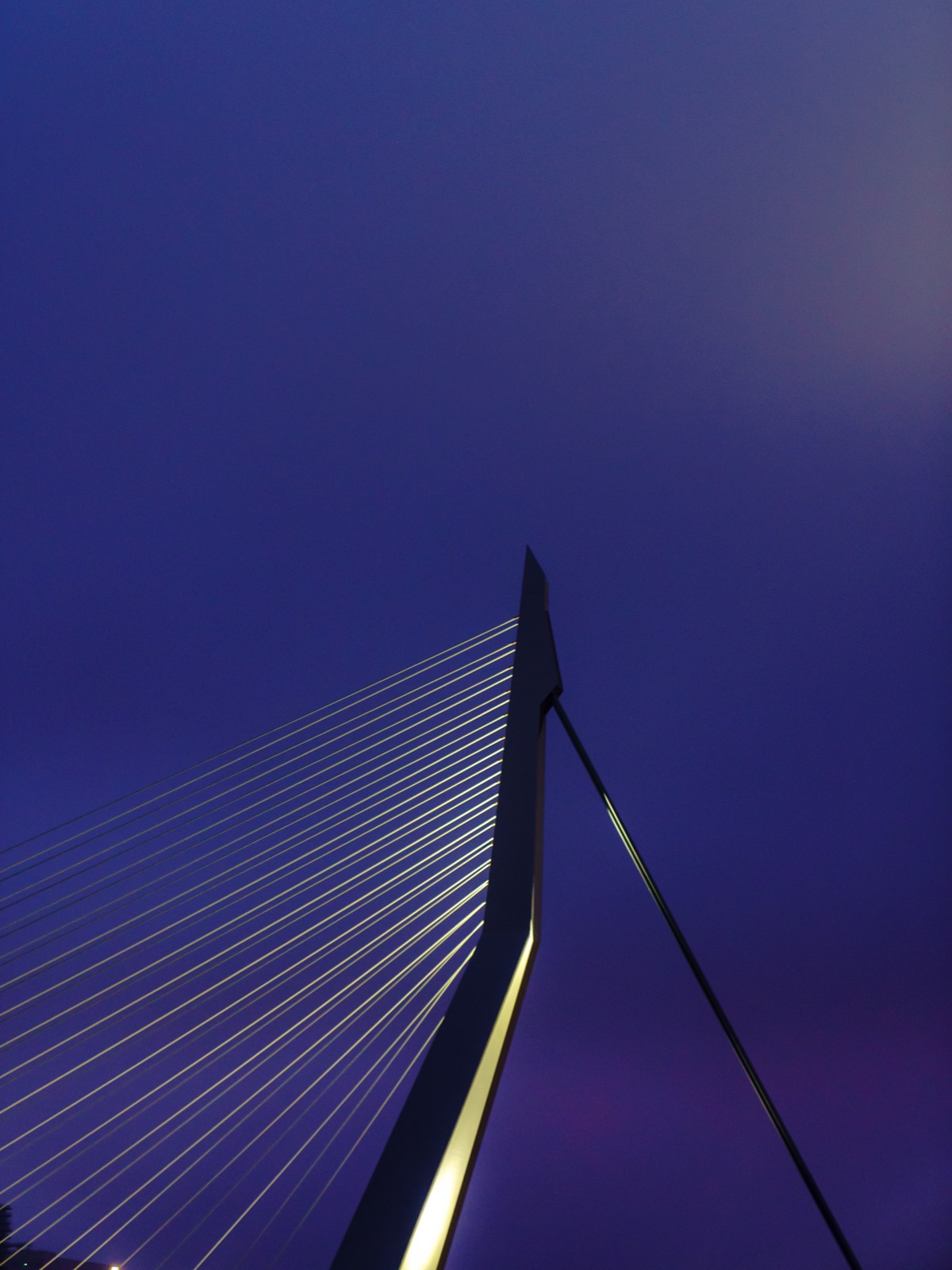
We’re kicking off our list with the mother of all bridges; Erasmusbrug. Constructed in 1996, the tallest bridge in the Netherlands is commonly referred to as De Zwaan (The Swan), for it’s swan-neck-like features. When thinking of a language, one can’t deny the grandiose shape of the bridge and the swan’s neck resembling the letter λ from the Greek alphabet. It also makes sense that the longest bridge in Rotterdam should represent the Indo-European language with the longest documented history – Greek!
The official language of Greece dates back at least 3,500 years and has influenced the languages north and south of its borders – a bridge, you could say.
De Hef – German
As languages go, German is one that always gets a bad wrap. Often cited as being an aggressive-sounding language, German is actually a language of philosophy, technology and science. It is among the languages most-commonly used on the internet, and has a very, very long history. It is true that German is a very practical language. It is well-structured, and serves to convey ideas effectively and efficiently.
Unlike its predecessor, De Hef was built with efficiency and purpose in mind, as a means of connecting Nooreireland with Feijenoord in the south. The bridge was the continuation of the railway line from Rotterdam to Breda, and after a boat struck its predecessor in the 1800’s, De Hef was constructed with a moving central part, to allow passing ships through. Its structure is plain to see, and just like German, looking at De Hef, you’ll see how each part connects to the other in a series of well-thought-out connections.
Willemsbrug – English
I must admit, the reason for allocating English, specifically the North American English dialect, was mostly superficial, as I believe it’s safe to say there is but one bridge that comes to mind when we look at Willemsbrug; The Golden Gate Bridge. Now this is not to denote Willemsbrug, it is definitely a stand-alone bridge, but the second reason was its positioning between a bridge we’ve already spoken about, De Hef and its neighbour.
In very close proximity to the German language, English shares a lot of linguistic history with its neighbour on the continent, being in the West Germanic Language family. English is an international language of education, business and communication. English is also the language of international politics. Because of its wide-use, English is arguably the most accessible language to learn.
Willemsbrug has many different points of entry for pedestrians, cyclists and cars, and if you’re cycling, Willemsbrug is a breeze! Not too steep, and a smooth ride, just like learning English!
Koningsbrug – Dutch
Nestled between English and German, this other West-Germanic language shares similarities to both. Dutch is closer to German, with 80% language similarity, with much less shared with English. To some, Dutch is a harsh sounding language with the ‘G’ a very prominent letter in the language. Others say that while Dutch is a beautiful sounding language, the grammar is quite difficult to grasp. In this respect, the location of Koningsbrug is perfect.
Both English and Dutch are category one languages, whereas German is the only category two language, having much more difficult grammar.
The look of the bridge doesn’t scream Dutch, but rather a Scandinavian language, like Swedish perhaps, but the positioning of the bridge, and the view of the beautiful Kop van Zuid meant that Koningsbrugge had to be given the title of Dutch.
All this talk of bridges and languages, really does get me thinking of how a language has two points of contact. The point where you begin with a language, and become familiar with how it works and how it sounds, and then when you become more comfortable with the language and you begin using it as a tool to communicate across cultures, bridging the gap, so to speak.